


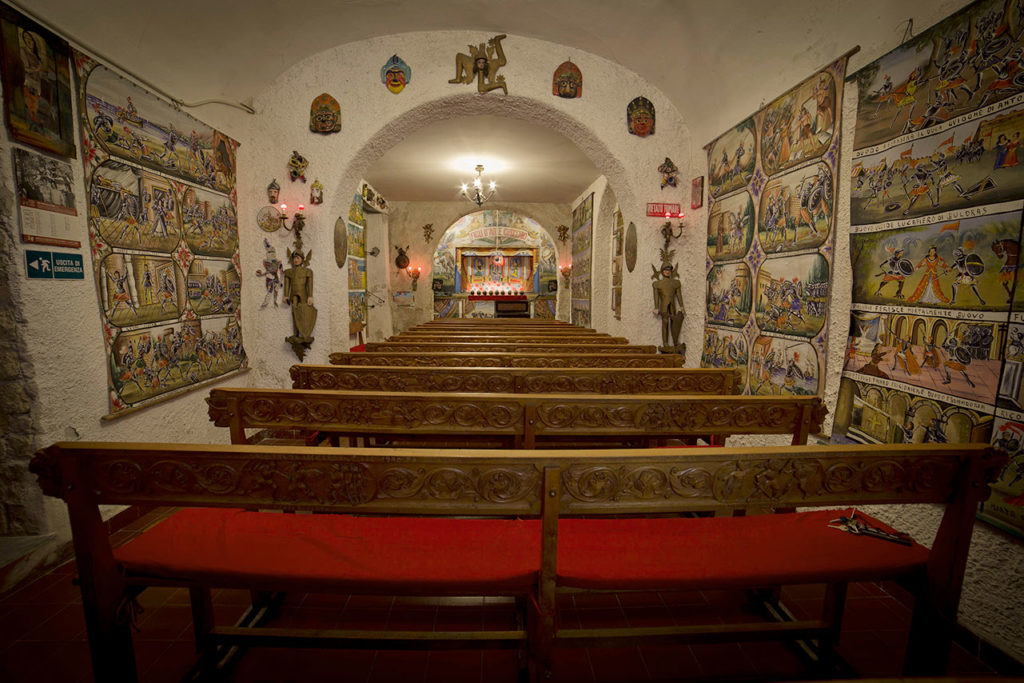
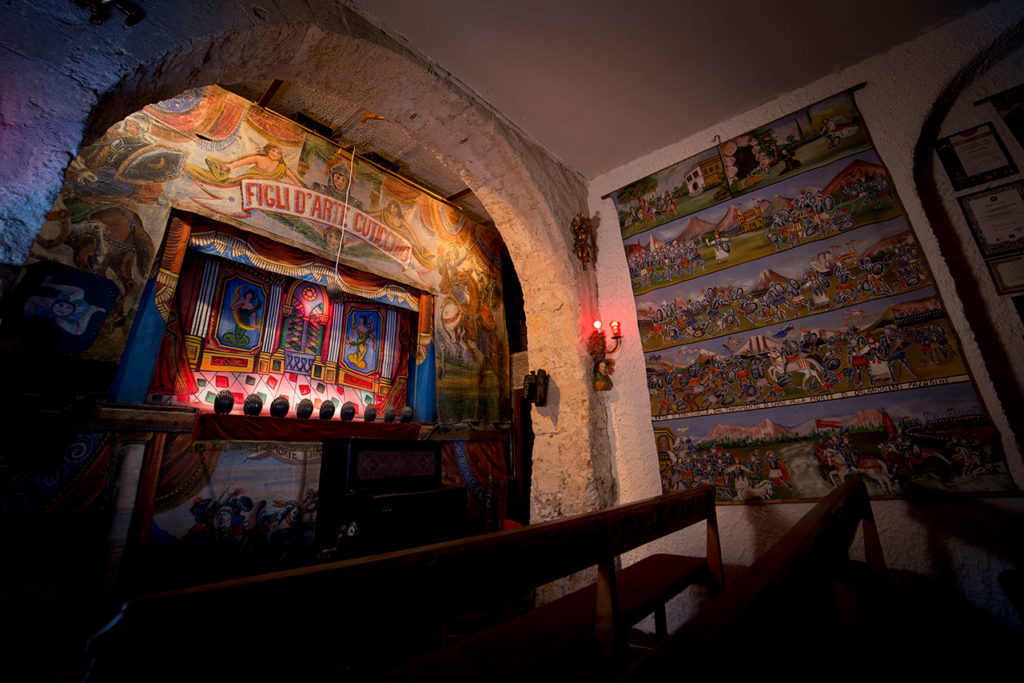
The Theater of Via Bara all’Olivella in Palermo is the heart and engine of a recent past and an open future. Since its founding – on July 18, 1973 – it has always aroused wide interest, both as a historical testimony and as theatrical research, continuously attracting local audiences and foreign visitors, including authoritative scholars and theater men, who write about it in their recollections with interest and wonder.
It is necessary to dispel a commonplace, which for years has conditioned the collective imagination, that Pupi theater is a form of entertainment intended, by its very nature, for an audience of children and tourists. In the golden age of this tradition, the audience consisted of regulars, whose attention was mainly focused on the History of the Paladins of France, which Giusto Lodico had collected from the living voice of the opranti and cuntisti (storyteller) between 1858 and 1860, publishing it in weekly handouts.
The numerous episodes of the History begin with the marriage of King Pippin to Princess Bertha of Hungary and end with the defeat of the Paladins at Roncesvalles and the death of Charlemagne. The Story was performed, one installment a day, for over three hundred evenings. The theater was the gathering place for a homogeneous group of spectators (women were excluded), who would never approve of shows where the narrative part was left out in favor of stage effects, that is, duels and battles complete with severed heads and bodies.
During the post-World War II period, the Pupi Opera experienced a slump. The crisis triggered by the bombs disrupted ways of life, cultural habits and crafts. The aftermath of the war, the dream of a job, the desire to leave behind poverty and devastation, and the emigration of entire households contributed to the disappearance of the traditional audience. Pupi opera lost its social and ethical function, gradually assuming the status of a folkloric product. The organized tourism of the 1960s and 1970s thus became the new main referent of the few small theaters that survived the crisis.
The remaining puppeteers had to adapt their full-bodied repertoire to a few performances, which simplified the narrative plot and made the most of all the scenic resources and spectacular effects. As a result, all craft practices related to the world of puppets, from the embossing of armor to the making of frames, from the painting of backdrops to the painting of posters, were also profoundly transformed or, in most cases, extinguished altogether. The disappearance of the traditional public on the one hand and the absence of institutions on the other led, in the early 1970s, to the surrender of the last master oprants, who directed their children to other professions.
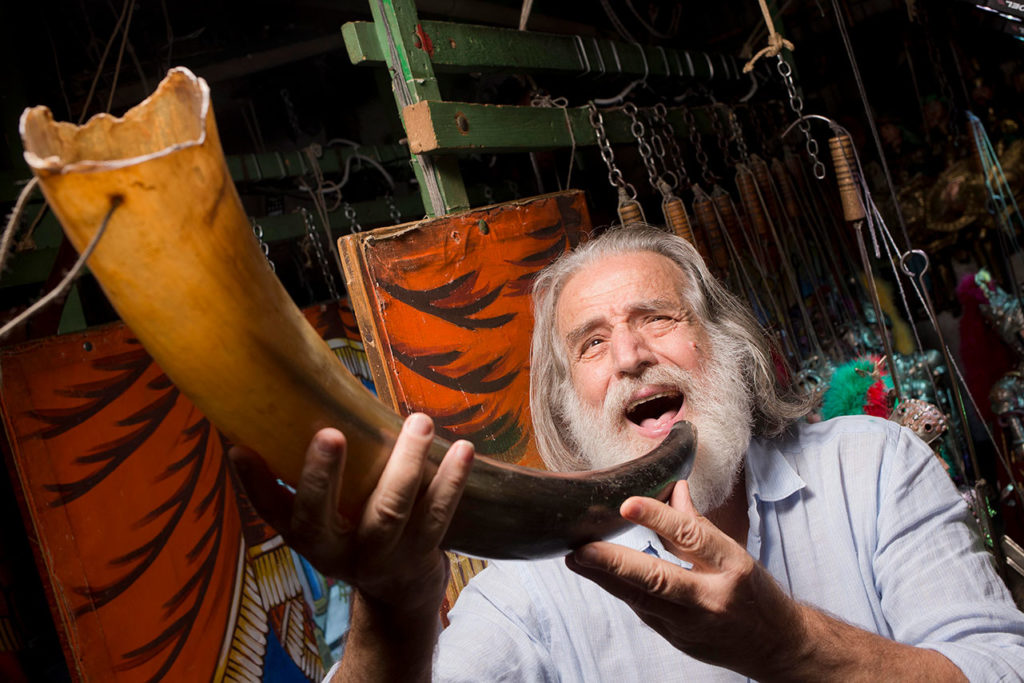
The only one to take the responsibility of going against the current, continuing his father’s trade, was Mimmo Cuticchio himself, who, involving his younger brothers, began to form a new audience, proposing the development of new scripts, which combined the rules of traditional staging with changing tastes, without betraying the historical roots of the classical repertoire.
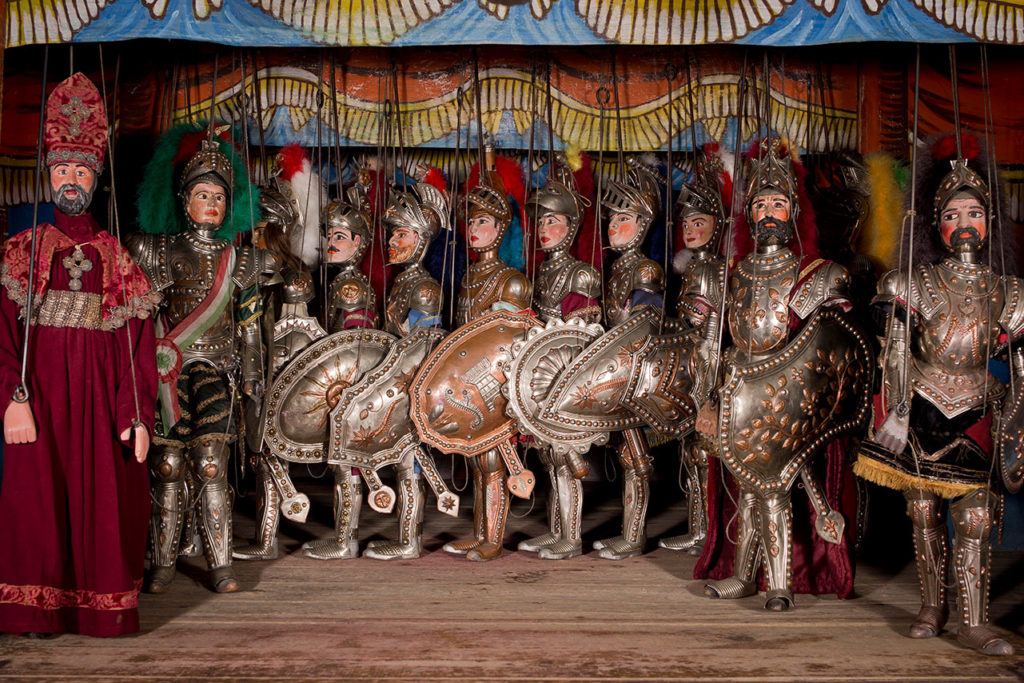
In 1977 he founded the Associazione Figli d’Arte Cuticchio, whose operational horizon is based on the preservation and dissemination of the immense intangible heritage of the culture of chivalry, which is accompanied by a very precious material heritage (puppets, backdrops, stage machines, costumes, canovacci, texts), not only memory but a living laboratory of creativity and communication, of research and protection of a cultural and spiritual universe of immense value.
The 1980s and 1990s were difficult years, but the continuous and constant commitment of this great artist, allowed to radiate new light, to give new life to the Theatre of Puppets, so much so as to enthuse and involve not only children and grandchildren of deceased oprants but also actors, groups, artists, directors, operating outside the traditional context, who, in their productions, have introduced, albeit in different ways, the use of the puppet or have been inspired by the vocal technique of the cunto, of which Mimmo Cuticchio is the latest representative in the field of epic-chivalric storytelling. Today’s scenario photographs a great liveliness, thanks to the experiences of some young companies that, more or less effectively, carry on their theater, while Mimmo Cuticchio remains a point of reference and stimulus, a pioneer and a champion of current research.